
Map CD Baby’s 2026 holiday submission dates, platform delivery and Spotify pitch checks before scheduling your release announcement.

If you plan a December music release through CD Baby, check the submission date now. An 11 December 2026 release reaches CD Baby’s recommended six-week lead time on 30 October. Uploading on the later platform-delivery deadline leaves out the distributor’s review stage.
CD Baby published its holiday reminder on 26 October 2026, covering releases from 27 November 2026 to 1 January 2027. Use it to put separate submission, delivery and promotion checkpoints in your calendar. These are CD Baby’s recommendations; ask your own distributor for its schedule if you use another service.
What the holiday notice actually changes in your plan

The CD Baby announcement recommends submitting at least six weeks before a release in that holiday period. It warns that a later submission raises the risk of missing the intended date. This is planning guidance, not a new universal streaming-platform rule or a guarantee that a six-week submission will arrive on time.
Start with the date you have already told collaborators or fans. Then open your actual distributor record. A finished recording, an uploaded file, a submitted release and delivery to a streaming service are different stages. Give your campaign the status that the record supports.
Work back from your release date
Here are four upcoming examples. The middle column is our calendar calculation: release date minus 42 days. The last column comes from CD Baby’s holiday delivery table, updated 21 October. Check that page again when submitting.
| Intended release | Six-week submission planning date | CD Baby's listed platform-delivery deadline |
|---|---|---|
| 11 December 2026 | 30 October 2026 | 4 December 2026 |
| 18 December 2026 | 6 November 2026 | 11 December 2026 |
| 25 December 2026 | 13 November 2026 | 18 December 2026 |
| 1 January 2027 | 20 November 2026 | 25 December 2026 |
The delivery column means the release should already have cleared CD Baby’s review and reached the platforms. It is not the day to start an upload. CD Baby also says that meeting this deadline does not guarantee availability on the intended release date.
For 27 November or 4 December releases, the same six-week calculation lands on 16 or 23 October. Those dates have passed. That is a reason to check the release’s real progress with the distributor now; it does not establish that an already-submitted release will fail.
Give each handoff its own evidence
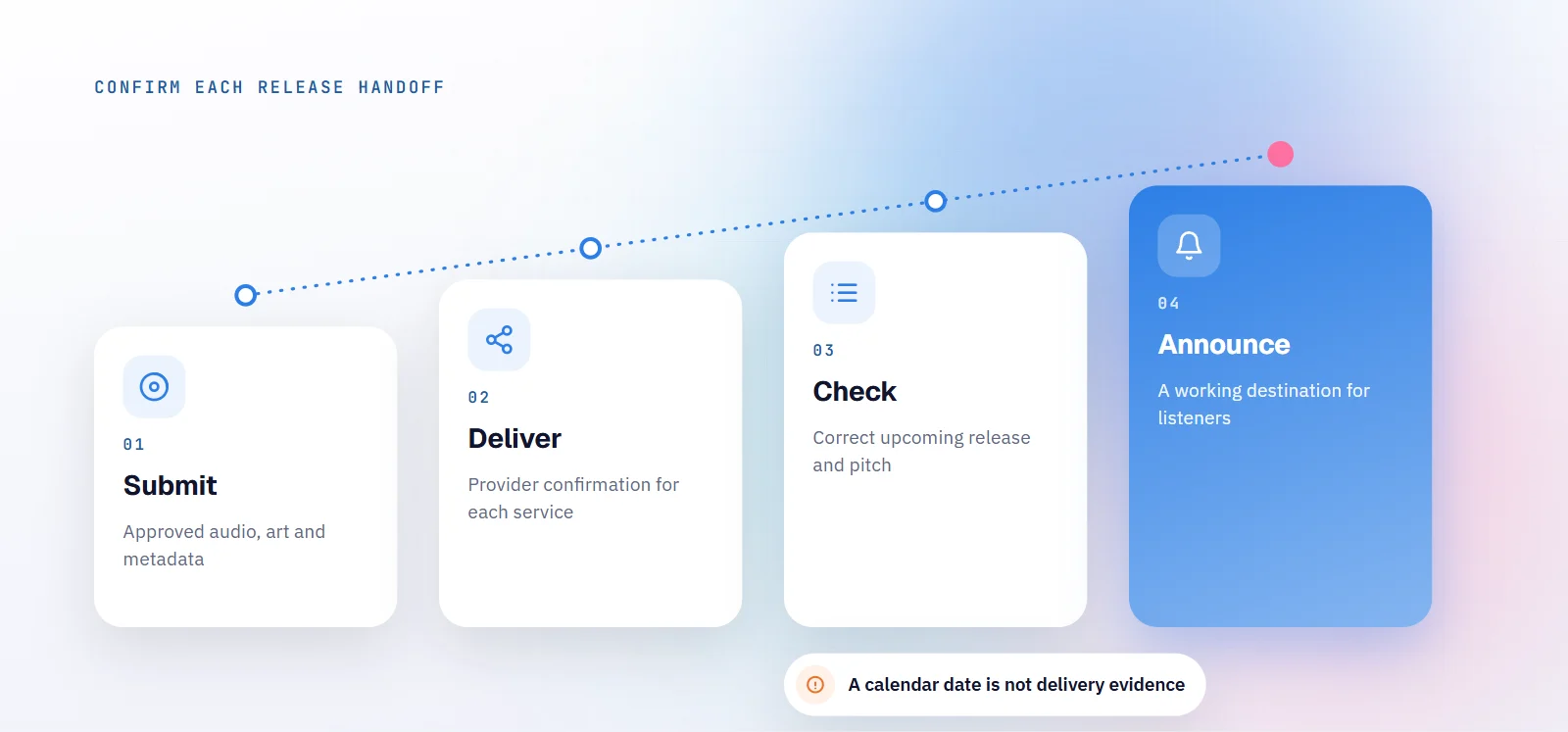
CD Baby’s distribution guide describes submission, inspection and partner processing separately. Corrections can send a release back through review. Build your handoff around evidence rather than a single green tick labelled “uploaded”.
Copy this small record into the folder you share with your manager, label or collaborator:
| Checkpoint | Evidence to keep | Person responsible |
|---|---|---|
| Submission | Completed submission record and approved audio/artwork filenames | ___ |
| Corrections | Requested change, response date and next status check | ___ |
| Delivery | Distributor's delivery status for the intended services | ___ |
| Upcoming release | Correct artist, recording, artwork and date where the platform exposes them | ___ |
| Promotion | Final destination, announcement time and person checking it | ___ |
Use simple status words: waiting, submitted, correction needed, confirmed. Put the next check beside anything waiting. If a collaborator sends new artwork after submission, record which file is approved before changing anything. This keeps an older export from quietly returning to the campaign.
Keep permissions for covers, samples and artwork in the same release folder. A seasonal theme does not itself establish that material is cleared. Resolve an outstanding permission before relying on the date in your calendar.
Leave room for the Spotify pitch
Spotify’s current pitching instructions let Admins and Editors pitch an eligible unreleased song from Music → Upcoming. You can pitch one song at a time; compilations and songs where you are only a featured artist are excluded. Pitching does not guarantee editorial placement. Spotify specifies at least seven days before release for a song pitch to select that song for followers’ Release Radar.
Delivery and visibility are separate checks here too. Spotify’s Upcoming guidance says a release can take around 48 hours to appear after submission via the distributor to Spotify. A file uploaded to your distributor five minutes ago has not necessarily reached that point. Check with the distributor if the release is missing or sent to the wrong artist profile.
That is why a delivery deadline exactly seven days before release leaves little room for a pitch check. Aim to complete the handoff earlier where possible, and verify the actual release time and time zone rather than relying only on dates in a spreadsheet.
Consider this fictional planning example, not a successful campaign: a duo wants its single out on 11 December. It prepares its CD Baby submission for 30 October and sets an internal check for 1 December to investigate any missing delivery evidence. It aims to finish an eligible Spotify song pitch by 3 December, if the release is available in Upcoming. That earlier pitch target is the duo’s working buffer, not a Spotify deadline or a promise that processing will finish by then.
If the release is still missing at the internal check, the owner asks the distributor about its status and revisits the promotion plan. Ticking the pitch task complete without a submitted pitch would hide the problem.
Keep the announcement behind the evidence
You can prepare captions, a performance clip and release artwork while delivery is progressing. Keep claims tied to the stage you can verify. “Out now” belongs with an available recording; a planned date should not silently become a confirmed delivery claim.
Before a scheduled announcement runs, check the actual destination on a phone. Is it the correct recording and artist? Is it available to the intended audience? Does the page describe a future release or music that can already be played? Put one person in charge of this final check so everyone does not assume someone else has done it.
If the date changes, review the actual scheduled announcements and linked pages. Updating a planning calendar alone does not change the distributor’s release record. Keep the original creative files so they can be revised rather than hurriedly remade.
Put the release and its next steps together
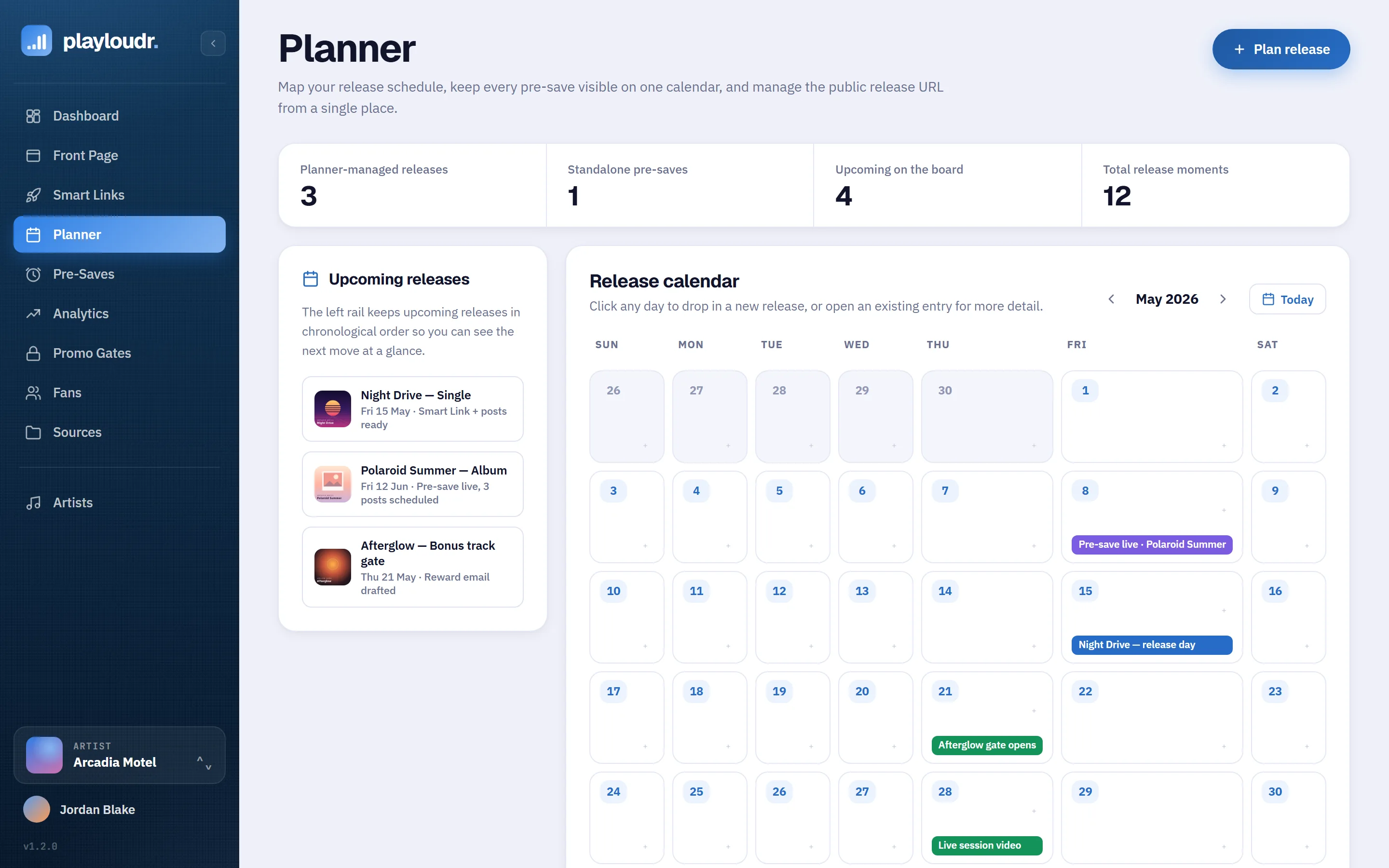
Use the Playloudr release planner to keep the release date and fan-facing pages together. Keep the evidence record alongside the release materials, and use the Academy’s music release checklist for the wider rollout. Playloudr helps organise the campaign; delivery and playlist pitching remain with the relevant provider.
The useful next step today is small: choose the intended release, find its real distributor status, and assign an owner to the next unresolved handoff. That makes the date useful before you spend another afternoon making the announcement.
Sources checked 27 October 2026. The holiday dates are provider-specific. The worksheet, internal check and fictional duo are editorial planning suggestions, not measured campaign results.
Sources and further reading
- CD Baby: Holiday music distribution deadlines for 2026 · checked 27 October 2026
- CD Baby: Holiday music release deadlines and submission guidelines · checked 27 October 2026
- CD Baby: When should I set my release date and how long does distribution take? · checked 27 October 2026
- Spotify: Pitching music and videos to Spotify playlist editors · checked 27 October 2026
- Spotify: Unreleased music in Spotify for Artists · checked 27 October 2026