
Prepare for the MLC’s 2027 distributions: check who administers each song, review shares and recording matches, and track confirmed corrections.

Before the MLC’s planned 2027 market-share distributions, give each song in your catalogue an administration check: who handles its US digital mechanical royalties, whether the work and your share are recorded correctly, and whether the recording is matched. Start with a manageable batch and keep a separate record of requests submitted and changes confirmed.
This is useful release housekeeping for independent songwriters and the managers helping them. Finding a gap does not establish that money is owed. The useful outcome is a verified record and a named person handling any unresolved issue.
What was announced, and when?
The MLC announced the plan on 30 September 2026, following its 29 September membership meeting. It intends to begin monthly market-share distributions in April 2027, starting with remaining unmatched and unclaimed blanket royalties from January 2021. Each subsequent distribution is intended to cover another usage month. The remaining pool is allocated proportionately using actual royalty distribution data for each digital service and offering. It is not divided equally among people who register. See the MLC’s announcement; this was a September announcement, not a new October launch.

Two terms explain the check. Unmatched means recording usage has not been connected to a musical work. Unclaimed means a work is identified but some ownership shares remain unclaimed. A song can therefore be present without every share being accounted for. See the MLC’s definitions and current plan.
Decide who should act for each song
The MLC’s membership guidance addresses people entitled to collect US digital audio mechanical royalties, including self-administered songwriters, publishers, publishing administrators and relevant collective management organisations. Membership is free. A manager or label should first establish who administers the relevant composition share; representing the recording artist does not answer that question.
If you administer your own songs, review the Member Hub route. If a publisher or administrator handles them, ask that organisation to confirm the work, your share and any correction it is handling. A mixed catalogue needs a decision song by song.
Writers with administered works can use the Songwriter Hub to inspect and export their catalogue and suggest recording matches. It also supports requests to correct writer names or IPI identifiers. Visibility into a song is not a reason to file a competing ownership claim. Resolve uncertainty about authority with the administrator or the MLC before making changes.
Copy this five-song review sheet
Choose five songs for the first session. If you have relevant recordings from 2021, include them; otherwise choose the works whose records are least clear. Five is a suggested workload, not an MLC rule or a claim that those songs earned royalties.
Use one row per musical work, with a separate list of its recordings. Keep supporting agreements and private account details in your own secure records.
| Field | What to write down |
|---|---|
| Song identity | Title, alternate titles, writers and the work identifier you find |
| Responsible administrator | Who handles the share you control, with a contact and confirmation date |
| Ownership evidence | The share supported by your records; flag disagreements for resolution |
| Recordings | Relevant artist, recording title and ISRC for each version |
| Observed problem | Missing work, unclear share, missing match, or no issue found |
| Next action | One named person, a specific request and a follow-up date |
| Verification | Submission reference, current status and the date the accepted change was checked |
The sheet separates three questions that often get bundled together: does the work exist, is the relevant share recorded, and is the recording connected to it? Leave a field marked “unknown” when evidence is missing. A completed-looking spreadsheet is less useful than an honest list of questions.
Search, check the share, then review matches
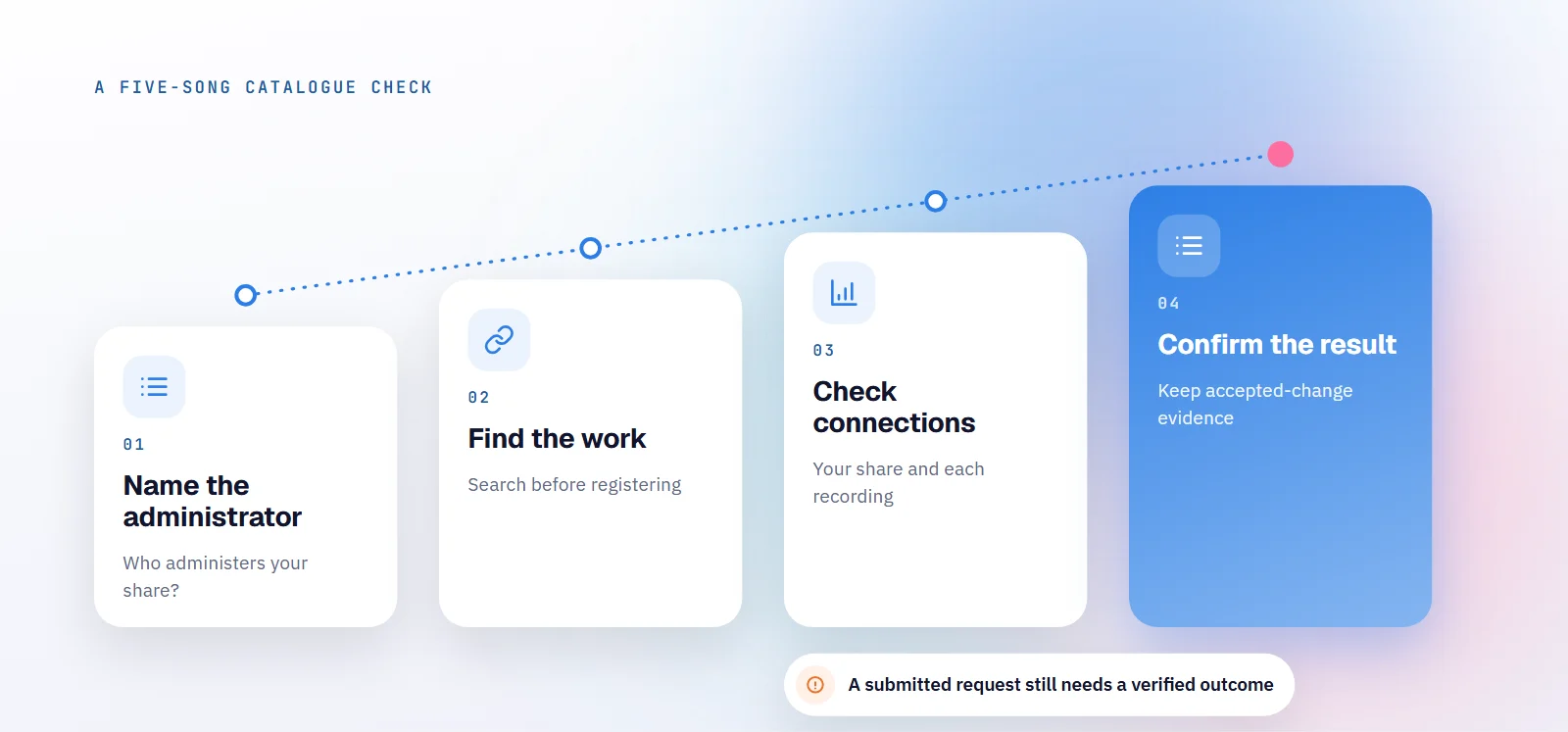
The MLC recommends checking for an existing work before registering another copy. Its publisher preparation guide sets out the underlying jobs: claim shares you administer, register missing works and review unmatched recordings.
Use the MLC’s tools guide to choose the appropriate action:
- Public Work Search: inspect existing work and ownership information without creating a registration.
- Claiming Tool: review an existing work for the share you are entitled to claim. If the work is absent, use the registration tools instead.
- Matching Tool: check recordings identified by ISRC and propose connections to the correct works. It is available through both the Member Hub and Songwriter Hub.
- Catalog Export: keep a dated copy for comparison after corrections.
Do not treat a submitted suggestion as an accepted match. Keep its reference and recheck the provider’s status. For a disagreement over shares or administration, collect the relevant records and ask for help before submitting conflicting information.
A fictional co-writer example
Suppose Maya wrote 40% of “After the Last Train” and administers that share herself. Her collaborator’s publisher administers the other 60%. These details are fictional and assume the shares are already agreed.
Maya finds an existing work entry. Her review row records that the publisher’s share is visible, while the status of her own share needs checking. She investigates the existing entry rather than creating another work with the same title. Separately, she compares the recording’s ISRC with the matches shown for that work.
Her task list can now be specific: resolve the status of her 40% share; investigate the recording connection if missing; retain each request reference; check the accepted result. Even if both issues are resolved, the sheet contains no estimated payout. That would require actual royalty reporting, not an inference from a catalogue correction.
Work backwards from the snapshot
The MLC currently plans to use a database snapshot taken on or around 10 February 2027 for its first April market-share distribution. That is a processing checkpoint, not a guaranteed last day to submit corrections. Registrations and claims typically take up to 21 days; matching typically takes about 30 days. Incomplete information and volume can extend those times. Check the current processing and snapshot FAQs before setting your own timetable.
The MLC also says later claims cannot recover royalties for past periods already paid out through market-share distributions. That makes checking the accepted record ahead of the relevant snapshot useful.
Start early enough to investigate rejected or unresolved requests. Give every open row a follow-up date and responsible person. At each review, count separately: songs checked, requests pending, and changes confirmed. None of those counts measures money recovered.
Connect the admin check to the next release
Keep this catalogue sheet with your release documents and use the Academy release checklist for the wider delivery and promotion work. The sheet gives you a record to revisit when a song gains a new recording, collaborator detail or administrator.
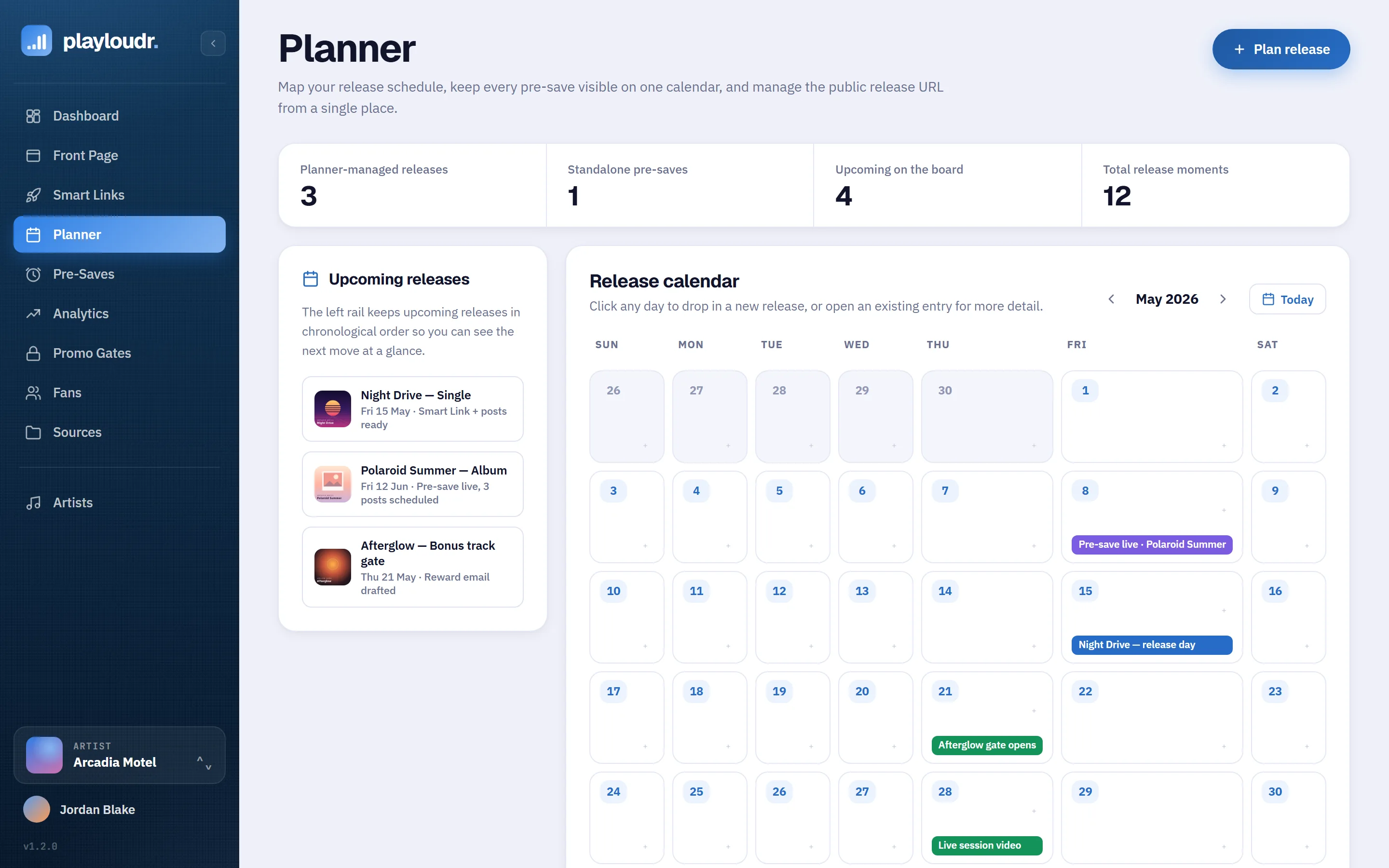
For the listener-facing plan, Playloudr’s release planner brings release dates and their campaign pages together. Put your next release on that calendar once its intended date is clear, and keep the administration follow-up alongside your other preparation. Royalty registrations and claims stay with the responsible administrator and the MLC.
Sources checked 29 October 2026. Recheck the MLC’s linked guidance for any changes to processing or distribution dates.
Sources and further reading
- The MLC: September annual meeting and first market-share distribution · checked 29 October 2026
- The MLC: Market Share Distributions and processing FAQs · checked 29 October 2026
- The MLC: Membership · checked 29 October 2026
- The MLC: Songwriter Hub · checked 29 October 2026
- The MLC: Three things publishers can do to prepare · checked 29 October 2026
- The MLC: Tools · checked 29 October 2026